
One of the most basic concepts of weaponized single combat is to get between your adversary and his weapon. For the cavalryman, that effectively means between his weapon and his horse. This play is a response for the cavalryman to an infantryman setting aside the lance and getting to the inside for a hit.
The Setup
(Both belligerents are assumed to be fighting right-handed.)
A clever and attentive infantryman who “sees you coming,” so to speak, may set aside and may seize the lancer’s lance. Typically, the lancer massively has the advantage on judging the moment of impact, being the one in motion, but if the infantryman’s spacing and timing is skillful enough, he can set aside to his left the tip of the lance with his left hand, then swing his sword (in this example, though any swung weapon may substitute) at the now open cavalryman.
Normally, our cavalry would mitigate this sort of move by “shrouding” the lance, keeping the adversary on the outside of the lance until the moment before impact. This play assumes that has failed, whether by the cavalryman’s neglect to shroud the lance, or by clever handiwork of the infantryman.
We counter this with the katar (push dagger).

The katar has langets on either side to allow some manipulation of the adversary’s blade; but more importantly, it typically has a quillon that curves upward (towards the tip of the katar’s blade), which we will use to trap the adversary’s blade.

The Play
Once the tip of the lance is past its target, it can do no damage. As soon as you detect that the infantryman has taken the lance and is getting inside, let go of the lance and prepare to transition:
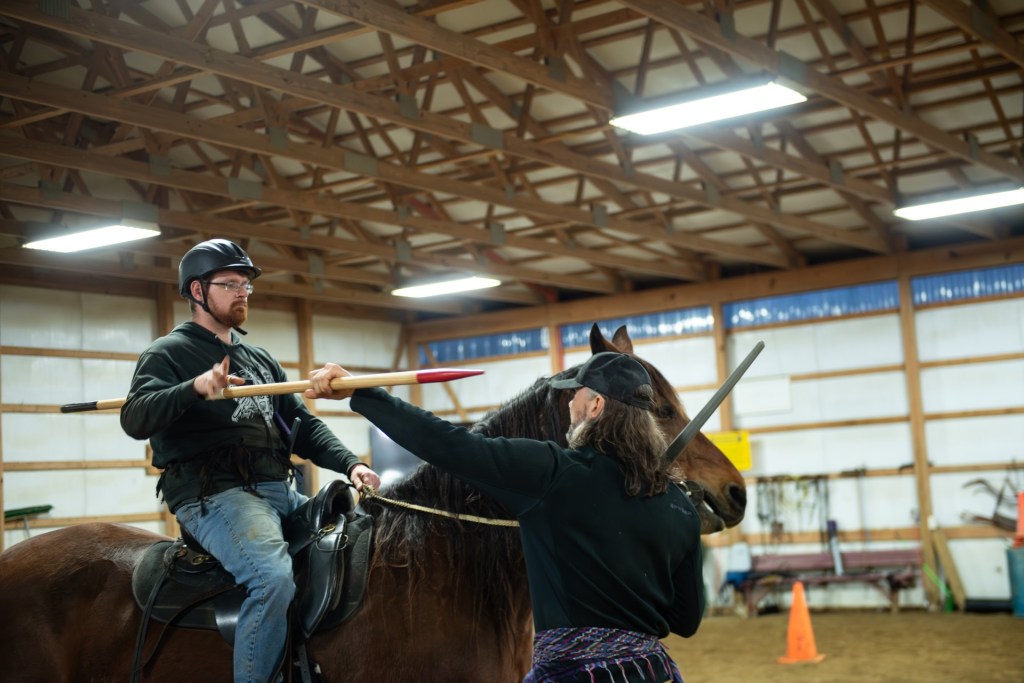
Immediately draw the katar. Carried in the waistband, point down to the left, the katar will be online with the target with the same motion as the draw, and is very efficient and fast—as well it must be, as the horse is presumed to still be moving forward, conducting you into the infantryman’s next attack.

The infantryman cuts a descending cut with his sword—top-down or top right to bottom left. Catch the edge of the sword in the quillon of the katar.
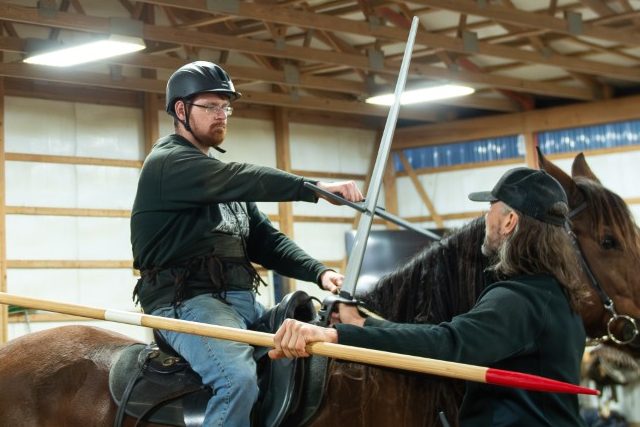
Continue forward to crowd the sword against the infantryman and drive the katar into him.

Carry on with the mission.
Some Considerations
The time between disarm and what happens next is short. The infantryman must be very fast to get between you and your lance; you must be even faster to react by transitioning mid-attack while at a canter. Katar placement and carriage matters. Your chances of pulling it off in a fight are greater than zero, but success is not assured. Nevertheless, the play has value as a Martial exercise in optionality, as a practical application of lance-to-katar transition and katar-on-sword play, and, practiced at full speed, a test of speed and fitness in manual of arms.
 Martial Equestrian