
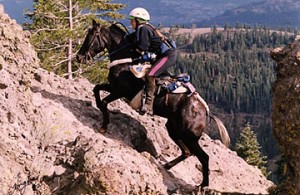
The Tevis Cup—a 100-mile, 1-day race in the mountains of California—is on today, and a lot of riders are dreaming about being one of the GPS dots on the map. But how do you get ready? We’ve put a few derby riders through our program and seen what works, what doesn’t work, and have some perspective about a realistic timeline for training that has good results. If you want to compete in the Tevis next year—or any other endurance race—here’s your one-year timeline to get prepared.
12 Months Until the Race: Learn Relevant Technique
One year out is about the time to start getting serious about your training, and most people start by trying to build up their physical fitness—but hold off on that. Step one is learning riding technique—relevant technique. There’s a misconception that dressage is just generally good for technique, but as I explain in this post, dressage technique is good for dressage, and bad for endurance races. You need riding technique that is sustainable and defensive over a long time and sometimes at high speeds, and keep your horse happy the while.
Martial Equestrian and Stable Riding cover those techniques in 2- and 3-day rider intensives—a small time commitment that will pay off for the rest of your lead up to the race, and for the rest of your life as a rider. Almost everyone who has gone through this intensive has said something like, “I learned more in the last 3 days than I have in the last 20 years.” A race finisher—and all of our graduates have finished—said, “This literally saved my life in the Mongol Derby.” Those who took our intensive for the first time closer to the time of the race agreed that this should have been the first step—so do this first! It will also arm you with a more educated opinion about what gear to ride in and what horses you should be practicing on.
Learn the relevant technique first so you can practice it for the rest of your training without trashing your or your horse’s bodies. Your knees don’t have to hurt, and you don’t have to tough it out.
12 – 8 or 6 Months: High Volume Riding
Now that you know what to do, it’s time to do it a lot. How you get your volume in depends on your situation. Join a trail riding club that puts in some miles; go to some fox hunts; ride several horses a day, several days a week at your barn. Get in “bounce time” where you can (only, after the abovementioned intensive, you won’t be bouncing anymore, to you and your horses’ relief), and try to stay close to conditions like the race (not dressage!) as much as you can.
That toughness you thought you needed with your body, now you’ll need it to stick to your training. You have time still, so don’t burn out, but—
Ride, ride, ride!
8 – 6 Months: Mock Derby
Now that you have some time in saddle with appropriate technique, let’s get you into a real long-distance ride emulating the conditions of a derby. Stevie and Dylan at Intergalactic Equine are the place for this. They are veterans of multiple endurance races and their training covers the gear you’ll be using, how to use the GPS, race-specific considerations (like how to pass your vet checks), and they will put you on an actual long-distance course to put everything you know so far to the test. You will also get a healthy dose of fitness training on the ground to make sure you’re up for the rigors of the race—some of which you may run on your own two feet.
You’re at the halfway point here, and your experience at Intergalactic Equine should be a reality check. Don’t expect it to be easy, but use it as feedback for what you’re missing.
6 – 3 Months: Remediate Your Weakest Points
You have been tested in realistic conditions. How did you fare? Does your technique work on the ride? Is your equipment right? Does everything make sense? Are you in good physical condition? Get back to your high volume riding, but focus on ironing out your weaknesses.
3 Months: Technique Class pt. 2
It’s been a while since you drank all that information from the firehose at the beginning of your 12-month countdown. Some things you might have forgotten, some things will have more context, and some things you will have mastered. Now it’s time to review, train with perspective, and upskill.
Now is time for the second intensive, where you’ve had time to practice for endurance riding seriously, and where technique training will be fresh when you go ride. Let’s do another 2- or 3-day intensive at Martial Equestrian x Stable Riding.
3 Months – 6 Weeks: Practice What You Know
There is still so much more to learn about the art of riding, no matter where you are on your journey, but now is not the time to learn it. Cut off new things and be sure you have mastered what you know so far. Eliminate distractions. Ride hard when you want to ride hard; ride easy when you need a down day—but ride, ride, ride, and without shiny distractions. La garrocha can wait until you come back from Patagonia.
6 Weeks and Beyond: Taper Your Training
You’ve given yourself time to train and trained appropriately; you’re in the best shape you can be. Time to dial back on your training and give your body and mind a chance to recover completely so that you are 100% on race day.
Keep exercising but exercise light and do what your body needs most—think of this stage of your workouts more like physical therapy. Keep a good diet and sleep schedule. Take walks in the woods. Meditate. Top off your tank.
One more word of advice: If you’re not ready, don’t go. There will be another race. Don’t throw away your efforts so far just to be miserable and possibly drop out.
If you’ve done all these things and treated your training seriously, realistically, and intelligently, the race will be not only a memorable experience, but an enjoyable one. Be a rider who’s smiling in every picture and means it. You’ve got this!
 Martial Equestrian