
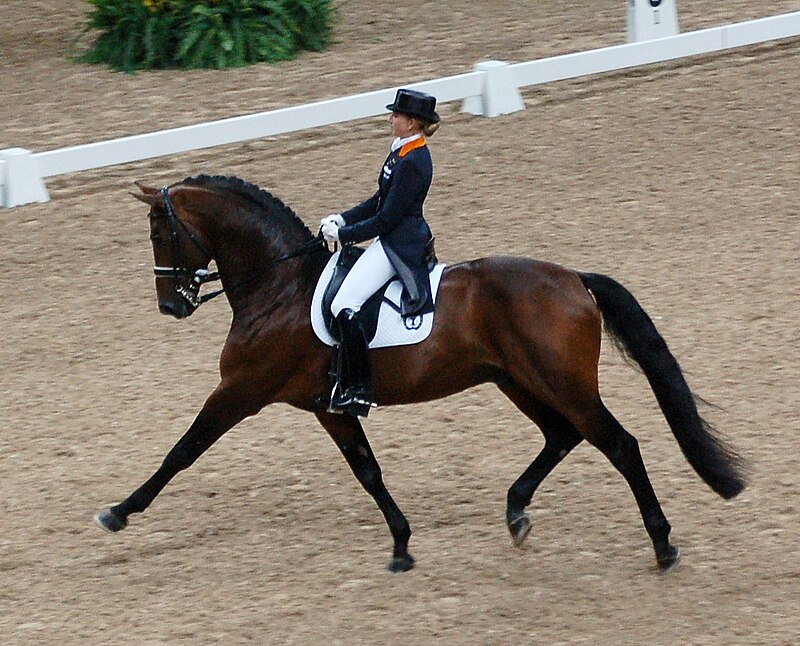

We train a lot of endurance riders preparing for the Mongol Derby, the Gaucho Derby, and the Tevis. All of our riders have finished. All of them have expressed some comment like, “I’ve learned more in the past 3 days than the last 20 years.” None have come with a seat and riding technique conducive to long riding, while tired, on semi-feral horses. And peculiarly, almost all of them take regular lessons in, of all things, dressage.
There seems to be some vague and sweeping notion that dressage is “the best” form of riding, the crème of technique—without qualifiers. Certainly, when one looks at what is possible with a horse beyond walking, trotting, and cantering, dressage offers a host of new maneuvres. However, there is precious little correlation between dressage training and endurance riding, and however much one might think s/he is learning more about riding in general, the lessons from dressage mostly do not transfer. Here are some ways dressage diverges from endurance riding:
1) Dressage is for dressage-trained horses.
A horse needs special training to do dressage. Some dressage apologists will disagree with this, but only with some mental gymnastics, as the case is weak. Try to ask your Mongol pony to do one tempis and it will tell you to take a hike.
2) Dressage utilizes a different breed/type of horse than the derbies.
The fitness and morphotype of the horse able to perform the extremes of dressage or the extremes of an endurance race are necessarily different. Their center of balance is different and their movement quality is different. Their head carriage is almost 90 degrees different. Mongol ponies don’t get chiropractic and PEMF, and dressage horses don’t go extremely long distances. The company ballerina’s body is not the marathon runner’s body. It can’t be.
3) Dressage uses different rider muscles than endurance riding.
Like the horse, the rider also requires specialized fitness. There is little overlap, and in fact the fitness for one is often antagonistic to the other. Getting very fit for one discipline can actually make you weaker in the other. At a casual level, you wouldn’t notice, but when it’s derby time and you’re training hard, you can’t be good at both.
4) Dressage horses travel slowly.
Your Mongol pony will not canter in place. This massively changes your situation because of inertia. Your ear-hip-heel alignment that is mistakenly taught in so many dressage circles will flip you right off the horse if it—and therefore you—is moving fast and suddenly trips. The threat of moving fast necessitates positions that accommodate forward inertia.
5) Dressage is performed in a small space.
The endurance rides—derbies in particular—cover huge distances. On any of the derbies, there are no walls to contain you, no letters to aim for, no return to the same place you were a few seconds ago, nothing to stop your horse from going full speed—with or without you, whether you’re on it or being dragged or left behind.
6) Dressage is conducted for a short time.
Your dressage training is usually 30 – 60 minutes. The tests are 9 minutes or less. The Mongol derby lasts for 10 days. Because of the brevity of dressage events, there is a certain level of intensity and focus that’s completely impractical in a derby. Sustainable riding is needed to get you through without suffering, as well as tactics to stay alert and safe over a long time, and that’s not what dressage does.
7) Dressage is for fair weather.
Have you ever ridden dressage in the rain and mud? If so, you didn’t have to. What you wear and how you sit when you ride is affected by the reality of the elements you aren’t exposed to in dressage.
8) Dressage uses completely different tack.
Because of the abovementioned factors, endurance riding uses different gear. This affects your riding. Try your dressage training in endurance tack and see for yourself. You’re not getting better at riding with endurance gear when you’re riding with dressage gear.
9) Dressage is Solo
If you’ve never had to ride in a group of horses, with horses acting out their social dynamics (like whom they disapprove of) and anxieties (like getting left behind), and if you’ve never had to ride your horse around other horses (so that you don’t collide and nobody gets kicked), then no amount of dressage experience will prepare you for it. Endurance rides are in groups, and group rides play out differently and require a different type of awareness and intellect to safely enjoy.
While many people treat endurance riding like it’s just riding, but longer, we’ve seen and demonstrated that riders get the best results riding as if they are riding for a long distance and time, with technique tailored to long rides on sometimes unpredictable horses. If you are one of the many endurance riders who studies dressage for your technique, stop treating the endurance part of your training as just needing more toughness and stamina, and start treating endurance riding as a discipline, with its own necessary technique. Toughness and stamina are consumable—you will eventually run out—but technique is not. All of our graduates, who all had extensive riding backgrounds, reported their riding being so much easier and less scary and having less pain after our technique clinics.
How do you get into a clinic? Drop us a line from the contact page or email directly at contact@martialequestrian if you want to schedule a 2- or 3-day clinic here in Ohio, or if you want to arrange for us to come to your barn.
 Martial Equestrian
One thought on “Dressage is Not For Endurance”