
Are you interested in mounted archery and considering thumb rings, but don’t know what you need, what design to use, how to start? Practical information follows.
Do I need an instructor?
No, you don’t need an instructor, and certainly not one who says you do. “You need an instructor” is toxic, gatekeeping rhetoric. Don’t get stuck in that mental hamster wheel. Remember that at some point, someone had to figure it out. You don’t need an instructor—you need to learn. That said, you might find someone who knows some things he or she can show you. There are, however, some weird dogmas out there about how to do things “the right way” that have nothing to do with actually using thumb rings effectively, so keep your critical thinking filter on, and be willing to pass on advice.
What’s the difference between thumb ring types?
We’ll look at four designs here and briefly go over what they do and how they work. They include: a shallow hook thumb ring, a deep hook thumb ring, the Manchu ring, and the Sugakji (Korean “male” ring). If you know a little about thumb rings, you might think that list has an odd taxonomy—a shallow hook thumb ring is not a specific type, yet a Manchu ring is. This list is, after all, for people looking to get started with thumb rings, and so is categorized by design.
1. The Deep Hook Thumb Ring
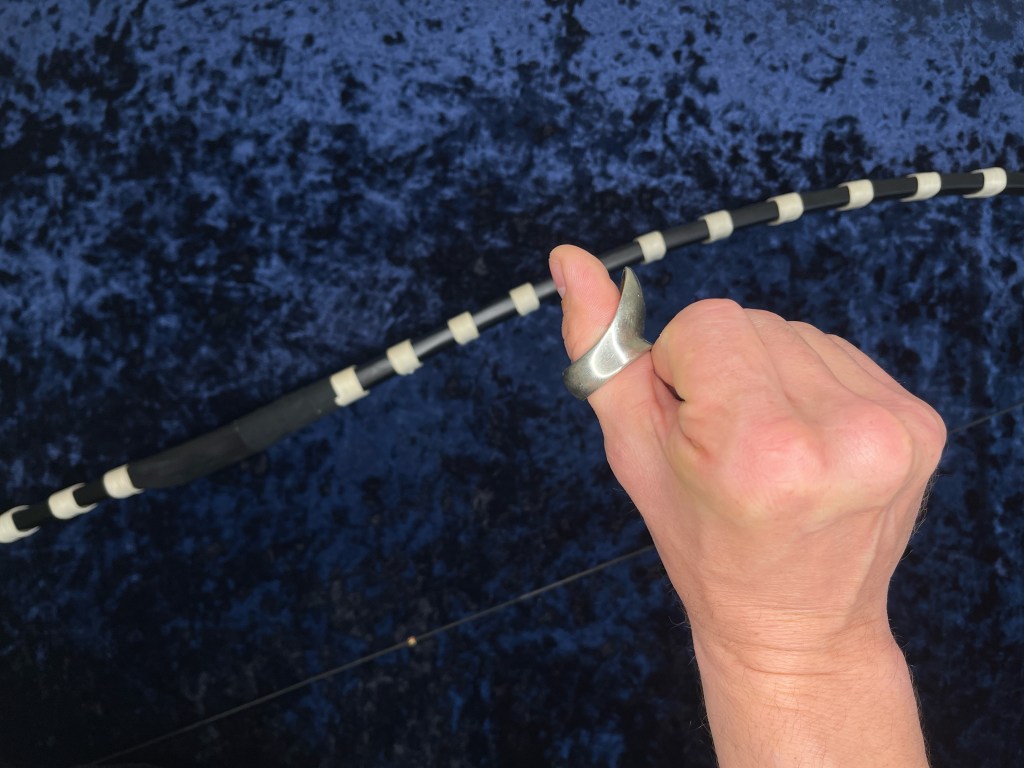
A deep hook thumb ring, as opposed to a shallow hook thumb ring, is used by curling the middle joint of the thumb all the way over the working side of the bowstring. The technique is the same as shooting with a bare thumb or shooting with a leather tab. You grab the string with your thumb, and the deep hook thumb ring is between your thumb and the string. A deep hook thumb ring is basically a hard thumb guard.

PROS: Because you use this ring the same way you use a bare thumb, most people find this type of thumb ring to be more intuitive or easier to learn.
CONS: They cover a lot of the surface of the thumb and can interfere with arrow handling and manual of arms, and reduce sensitivity.
The typically long ramp on the front can accidentally hook on the string while trying to nock.
Because no fleshy part of the thumb is touching the arrow or string, it is also very slippery.
These reasons all make the deep hook thumb ring a little slower to use. A leather thumb tab works exactly the same way and has none of these problems.
2. The Shallow Hook Thumb Ring

A shallow hook thumb ring, as opposed to the deep hook thumb ring, hooks under the front of the ring, and acts as a trigger, not unlike a guitar pick on a guitar string. If you trap the thumb with the index finger (making a sort of knot with the finger, thumb, arrow, and string called the “lock”), the distal phalanx (the end part) of the thumb does cross the string, but the thumb is not holding onto the string—the underside of the thumb ring is.

PROS: The operation of this type of ring is small and efficient. Shallow hook thumb rings tend to have a short ramp on the face and can “clear” the string when nocking while keeping things close. If you’re shooting for speed, this really can’t be beat.
CONS: The string, when trapped, is held under pressure at a corner between the underside of the ring and the flesh of your thumb. Depending on the toughness of your thumb, how thin the string is, and the poundage of your bow, this can chafe.
Because shallow hook thumb rings tend to be small, they can fall down the thumb sometimes, especially if you have a knuckly thumb.
Both of the above problems are remedied by a leather tongue called a “kulak,” or by wrapping a piece of tape around the thumb under the thumb ring.
3. The Manchu Thumb Ring

Effectively a shallow hook thumb ring, the Manchu ring is easily identified by its large, cylindrical shape. It “traps” the working side of the string and works as a trigger.

PROS: Because of its height, it doesn’t fall down the thumb—in fact, you’ll be hooking the string back near the base of your thumb.
Also because of its height, there is more surface to distribute the weight of the string across the thumb—with proper fit, this can be a very comfortable ring.
CONS: The Manchu ring takes up a lot of real estate on your thumb. You lose even more access to the use of your thumb and sensitivity than with the above-mentioned rings. Even pulling arrows out of the quiver is more difficult than with rings that expose the bottom of the thumb.
Many modern Manchu rings are made with 3D printing and have a rough, woven pattern going across the direction the string needs to pass, which creates unnecessary drag.
4. The Sugakji
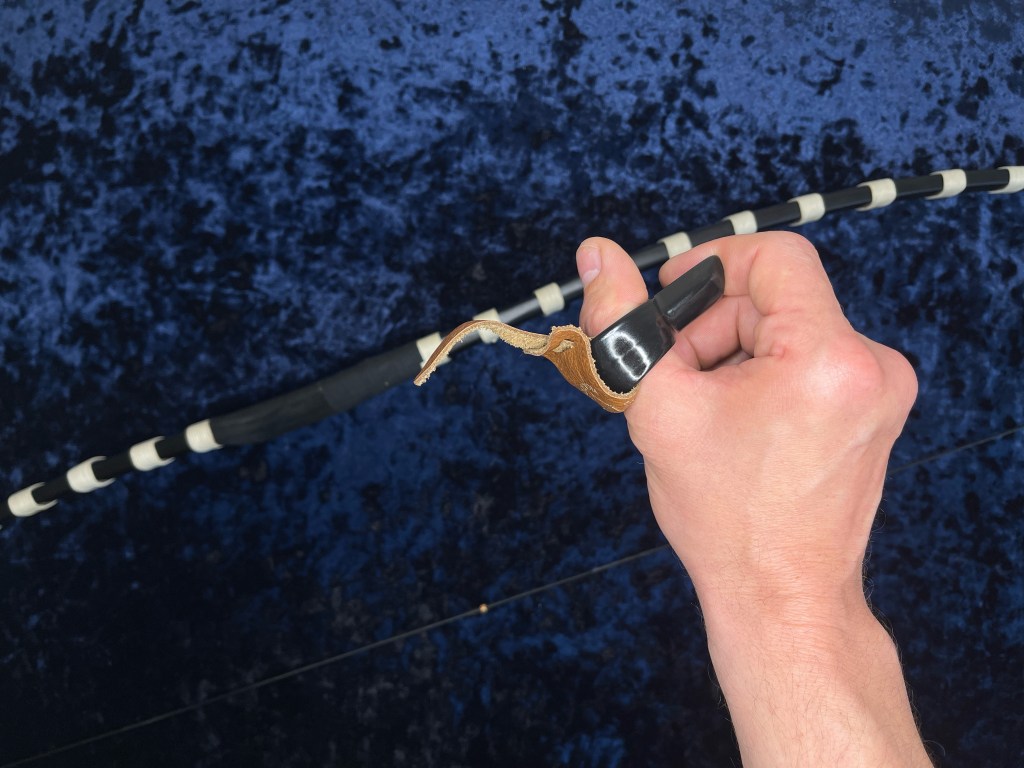
The Sugakji, or “male” ring, is particular to a traditional Korean style of archery. It has a phalange-like projection out the front (hence the “male” designation) that bars the working side of the string and is held down with the index finger. It also works as a trigger, but the trigger is the bar against the finger, not the ring against the string. A tapered strip of leather can be passed through the back to tighten the fit.

PROS: Like the deep hook thumb ring, the Sugakji takes the entire weight of the string, without any of it touching your thumb.
Holding down the bar with the index finger is strong and feels intuitive.
CONS: The projection gets in the way of manual of arms and is easy to hit and turn the ring sideways. Unlike with the other rings, however, it is easy to turn the ring back into place with the fingers of the same hand.
Fitment is tricky since the directional tension of the string tries to push the ring off.
Conclusion:
It’s perfectly fine to have one of each of these and shoot each one until you have a favorite, or just shoot whichever you’re in the mood for. Keep in mind that people usually have to try out several rings to find one that fits, and even if it seems to fit, some heavy shooting might reveal that it does not. (Typically, you will be best served with the tightest ring you can fit onto your thumb.) Be willing to go down in weight—all the way down—to test or troubleshoot thumb ring issues, especially if you are hurting your thumb.
Have fun!
 Martial Equestrian
One thought on “How Do You Choose a Thumb Ring?”