
[Original post on Facebook here: https://m.facebook.com/story.php?story_fbid=pfbid0BQrnCukY47JrTuXF826T2XSaRZowfAydhc97Qr4DWG5QfxMUKBsBYw7TFxtH7qWkl&id=100083245874712]
We saw this depiction circulating of a Mamluk performing a lance—>bow transition. It happens that weapon transitions are a favorite topic of ours, so we had a go.
To clear the air, before we dig in, I do NOT take for granted that “historical” implies “effective” or even “true.” I’m NOT disputing whether or not this is historical, or trying to determine its historicity, or agreeing or disagreeing with the illustrator (Matthew Ryan) or the commissioner for the illustration (David Nicolle). I saw a technique and wanted to attempt it. It might as well have been in a comic book, for our intents and purposes. We are Martial technicians and interested in Martial technique in practice. For what it’s worth, people more interested in the historicity have pointed out that the text this supposedly derives from does not advise this technique at a canter, but while standing–in other words, that this is a mistranslation.
As pictured (picture 1):
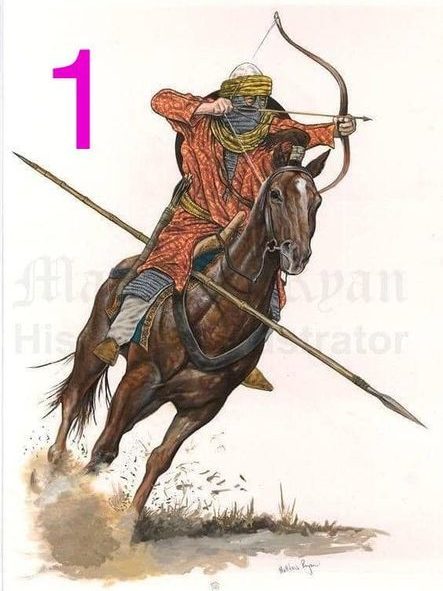
First of all, the illustrator (Matthew Ryan) is incredibly skilled and has done a great service for the subject of military history, and I’m sure is informed by whatever limited data are provided. The picture shows the lance tucked under the knee, lance head down to the front, shoe up to the rear, apparently without stirrups. If you ride and handle weapons, it shouldn’t take a lot of imagination to figure out how to get here: swing the right leg over the lance and trap it.
So we tried this orientation first: lance head down to the front, lance shoe up to the rear, no stirrups (picture 2).

Problems:
Despite no stirrups, allowing the knees to drop down, the knees still have higher relief from the saddle than the thigh or calf—there’s a hollow spot under there. You really have to squeeze the knee pretty aggressively to hang on. The inside of the knee really doesn’t like that—and this is just practice, not battle, don’t forget. Now the horse is compliantly steering left, which I don’t particularly want to train her not to do just for the sake of this trick—not for a horse I need to be able to steer while my hands are busy spilling blood.
What’s worse, the lance in front of and behind the knee is hitting high spots on the horse (the shoulder and the hip or stifle), spots that move. With just the right anthropometry/hipponometry, it might all fit together nicely, but that’s a really big “if.” Not useful or realistic for an entire army. This way is out.
Also, given the choice, I’ll take stirrups to battle—and I don’t suck without stirrups, and neither do any of these riders who tested this.
So again, with all due respect to the illustrator—and I do have respect for this illustrator—this configuration (if this method was actually used) seems improbable.
Next orientation: with stirrups, lance head down to the front, tucked between the leg and saddle/stirrup leather.
This requires tucking the lance in from the front, shoe first, which is a bit awkward. All the above problems were amplified, in addition to the threat of the lance getting tangled up when you drop it, between the foot and the stirrup leather (which puts the lance head pointed at the horse’s body on its way out).
Next: no stirrups, lance head up to the front, shoe down to the rear, between thigh and saddle (picture 3):

This put the lance perpendicular to the thigh and under the meat of the thigh, and immediately works better—if only for this stage of the transition (stowing the lance before readying the bow), but it came at the cost of having the front of the lance all up in the rider’s workspace. Reins were hard to manage, and managing a bow and arrows was untenably awkward.
The pommel on the Abetta helped to keep the lance out of the way, but then the lance head was perilously close to the horse’s head.
Next: stirrups, lance head up to the front, between thigh and saddle (pictures 4, 5):


This was very tight when standing up in the stirrups, only, and only with the pommel on the Abetta. It only sort of got in the way with the archery. The problem here is that you’re stuck standing in your stirrups throughout the whole maneuver, and if you ride horses that bolt, spook, or do any of the things that horses do when menaced (such as in combat), you’ll know that sometimes you need to sit down. It’s tight, it works when it works, it’s unreasonably conditional.
Next: stirrups, lance head down, under the stirrup leather (pictures 6, 7):

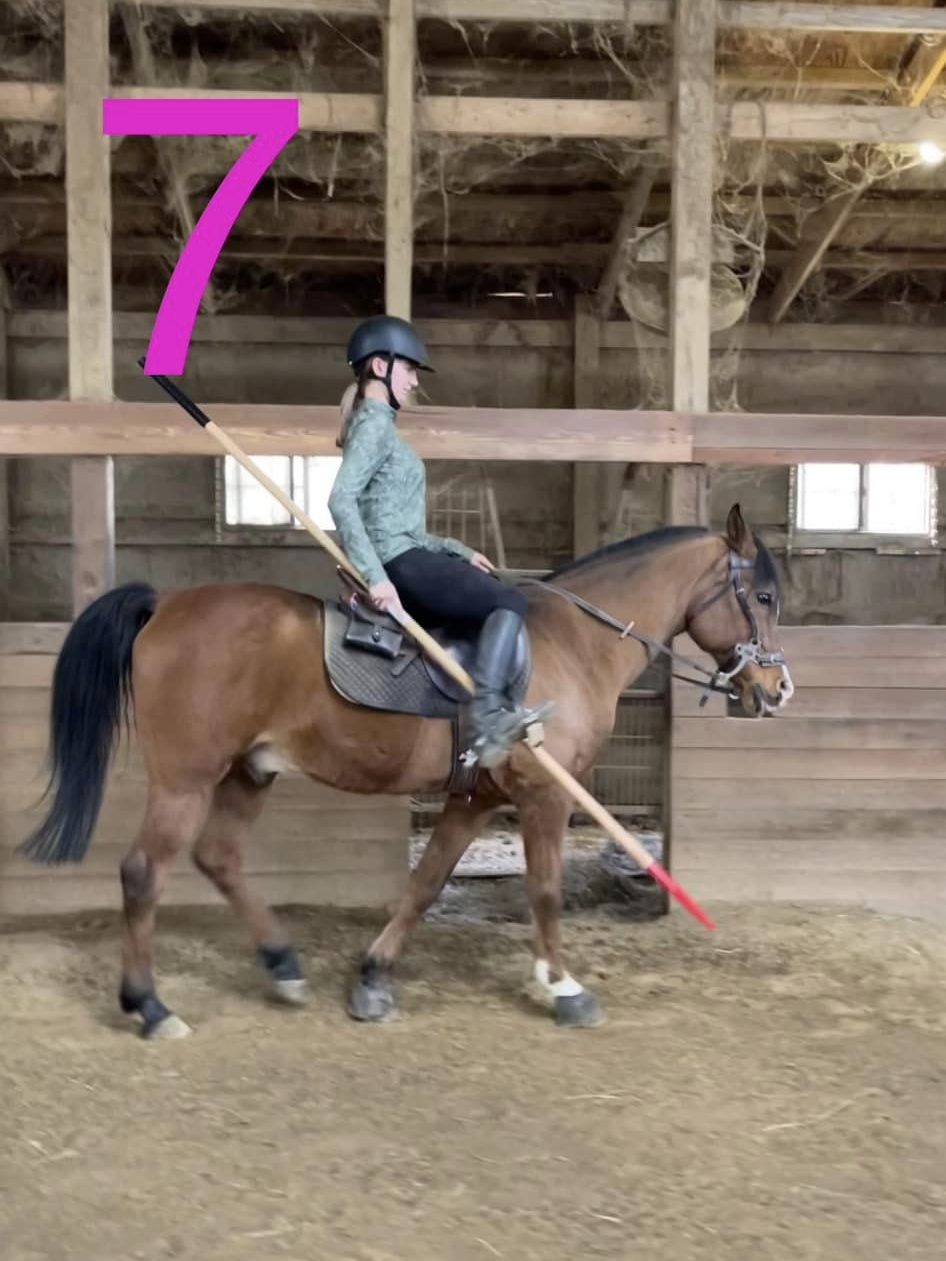
Our most success came from tucking it under the stirrup leather. I felt a little better about this in terms of safety because the lance is less likely to get tangled with the rider than it is when between the leg and the stirrup leather. Here you see it on two saddle types: one English, and one Abetta (hornless Western synthetic). Granted, neither of these are museum replicas of Mamluk saddles, but the ones I have seen don’t look particularly better suited to the task. If you disagree, prove it.
Our English rider fared better than the Abetta rider, for two reasons:
1) The English leather was stickier and gripped the lance better
2) The back end of the lance was caught by the sandwich case
That latter point bears repeating. Hardware on the saddle held it up. Everyone involved in the exercise felt like there should be something on the saddle to hang the lance from. And if this was done, I think they would have thought the same thing.
We found no orientation that facilitated both light and deep seat.
Here are our final results from this go around: https://fb.watch/o988G9vtnQ/
Purport:
We’re not Mamluks, or professional military lancers, admittedly; but even if we were, would we train our asses off to get reasonably good at this technique, when there are arguably simpler and more reliable options?
It’s not robust. That is, it’s a bit tricky, the conditions have to be right, and the likelihood of failure is unreasonably high. Sure, you can train to get good at it, but why waste time on such a finicky technique? That’s like doing a spinning jump kick in a street fight—you might even pull it off, but it’s so risky that you’d have to be pretty crazy to try it. I’ll concede that stupider ideas have crept into military doctrine—just look at the Tae Kwon Do manual that was in US Army circulation for a while. (And what will the history books say about that in a few centuries? “Historically, the US military high-kicked people in combat”?)
There are always some remarkable individuals capable of performing seemingly impossible feats—individuals, not armies or peoples. That’s one of the things we test for here. Just because I can pull it off doesn’t mean it passes—if I can’t teach other people to do it, and if other people can’t do it at speed, repeatably, it’s not robust, and I throw it out.
I think it can be done, but that doesn’t mean it should be, and certainly doesn’t mean that it was done (on the battlefield). And even if they did, so far I don’t agree that it’s feasible, or Martially effective. There are too many “ifs” that have to be right.
It would take some training with the horses at the expense of leg aids. Someone here will probably cherry-pick a “Yeah, but—“ but if you take away your leg aids and you use both hands for a weapon—and you’re not on a taped-off lane or tilt rail (a la mounted archery sport and jousting, but not combat)—then you really don’t have an effective fighting platform.
This was our, and our horses’, first go; and I’d like to play with this as an exercise, for practice, for fun. I think after a few tries, we will be able to manage something actionable. But I’m really having trouble swallowing that this was ever battlefield-ready. Not impossible, but unlikely.
No toxic armchair generals here, if you please. If you think I’m wrong, I don’t have to be right—but prove it. Canter with a lance tucked under your leg while shooting a bow and hitting the target—or better yet, get a bunch of people to do it like we did—then opine about its combat efficacy.
TL;DR: It’s doable, but a bad idea. Whether or not it was done historically, it’s not a robust technique.
 Martial Equestrian